
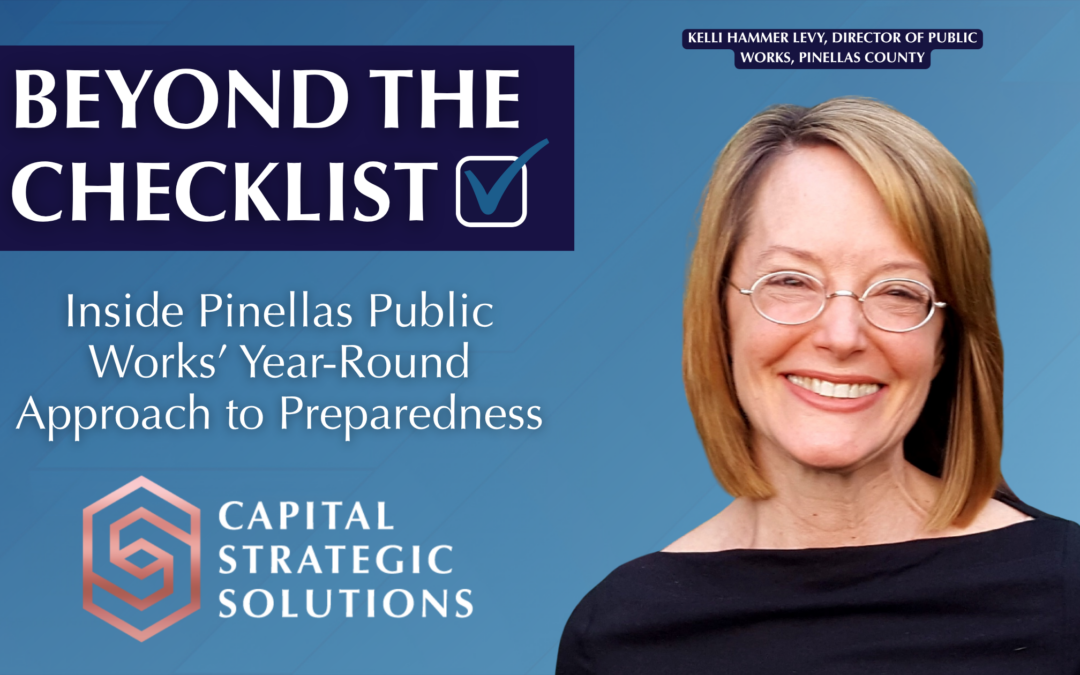
September 2026 – For many households, hurricane preparedness begins when a storm appears on the forecast: water gets bought, batteries get checked, furniture gets tied down. For Pinellas County Public Works, it begins long before a storm has a name and continues well after hurricane season ends.
The department maintains more than 200 known flooding hot spots, runs mock emergency exercises, coordinates with contractors and municipalities, manages aging infrastructure, and updates its plans with lessons from past storms. The goal isn't a seasonal checklist — it's the systems, relationships, and workforce needed to respond when conditions change fast.
That distinction matters in a county surrounded by water, linked by barrier islands, and responsible for infrastructure serving communities with very different risks. It also matters because emergencies don't always arrive in the form people expect.
When Preparedness Becomes Response
For Public Works Director Kelli Hammer Levy, National Preparedness Month turned from planning to active response this year when Pinellas County faced a mosquito-borne virus advisory with multiple dengue cases and West Nile detections in more than 60% of its sentinel chicken coops. It wasn't a hurricane or a flood, but it demanded the same systems: defined roles, reliable information, coordinated decisions, and constant communication.
Mosquito Control is staffed for normal operations, not a large-scale emergency, and when a backup contractor fell through and neighboring counties faced the same surge, mutual aid wasn't an option. The county had to organize its own resources for a response that couldn't be treated as a short sprint, activating an Incident Command System framework, issuing situation reports, and built a steady operational rhythm.
Just as important, leaders focused on sustaining the people doing the work.
"We knew immediately this would be a long haul, so we focused on our people first," Levy said.
That meant real breaks, a realistic pace, and cross-training other Public Works employees so licensed mosquito-control technicians could stay focused on the work only they could do. Clear schedules, assigned roles, regular check-ins, and constant communication let the department adjust as conditions evolved.
Pinellas hadn't seen locally acquired dengue in more than 30 years, the response meant learning in real time while building systems that may be needed again.
Preparation Starts After the Season Ends
Preparedness is usually discussed as the weeks before a storm. Inside Public Works, it's a continuous cycle.
When hurricane season ends, the department debriefs, even after a quiet year, examining what worked, closing gaps, and updating plans while the experience is fresh. Before the next season, Public Works inspects and maintains its 200-plus flooding hot spots, finishing by June 1, and runs two or three mock events to stress-test its technology.
Planning extends beyond county staff: Public Works meets with debris-management and monitoring contractors to review response plans, debris sites, and expectations for the year ahead, settling responsibilities before communities are dealing with damaged roads and downed trees. The work is deliberately uneventful. When systems perform as intended, the months of inspection and coordination behind them may never be visible to the public.
Lessons Written by Helene and Milton
Year-round planning proved its worth in 2024, when Hurricane Helene's flooding and Hurricane Milton's winds hit Pinellas in rapid succession. The two storms exposed vulnerabilities no exercise could have revealed: flooding at the Public Works campus itself delayed the department's ability to mobilize, a reminder that emergency operations are only as resilient as the facilities behind them.
Public Works responded by reinforcing buildings, improving stormwater maintenance with neighboring communities, and revising plans around what employees experienced firsthand.
This year's Preparedness Month carries that weight. The department isn't planning for an abstraction, it's applying what recent storms revealed about its infrastructure, facilities, and procedures.
Different Locations, Different Risks
Pinellas County's geography adds another layer. Barrier-island residents and inland residents face different hazards, but neither can assume they're safe. For Clearwater Beach and other coastal areas, major storms can bring life-threatening surge and flooding. Levy's advice is direct: barrier-island residents shouldn't stay put during significant coastal events like Helene.
Inland residents shouldn't read "no evacuation zone" as "no flood risk." Milton caused widespread inland flooding, proof that distance from the coast doesn't eliminate the threat.
The risk changes with each storm, so residents should know their property's actual exposure, follow official information, and check tools like the county's My Flood Risk application rather than relying on past experience alone.
"Make a plan and commit to it," Levy said. "A clear plan beats scrambling under stress, and early decisions prevent dangerous last-minute evacuations."
Following mandatory evacuation orders protects individual households and preserves limited emergency resources for those who need them most.
Planning for This Season and the Decades Ahead
Some vulnerabilities can't be fixed with seasonal maintenance alone. Much of the region's infrastructure is decades old, so Public Works balances immediate readiness with long-term investment, using asset-management systems to evaluate infrastructure, predict risk, and flag where repairs or capital improvements will be needed. Funding isn't always available, but understanding the system's weaknesses lets the department plan more deliberately and respond more effectively when failures occur.
That long view matters in a county with 24 municipalities, emergencies don't follow jurisdictional lines, so coordination starts well before an event. Pinellas and its cities align through shared debris contracts and annual preseason planning meetings, and state requirements now call for every municipality to identify its own debris site.
Preparedness Without a Named Storm
Flooding in Pinellas isn't limited to hurricanes, king tides and other conditions cause "sunny-day" flooding even with no storm approaching.
Public Works builds those risks into its outreach through community events, social media, and efforts like "Floodplain Friday." In recurring problem areas, the department installs backflow-prevention devices and uses King Tide events to help residents understand how drainage and tides interact.
It reflects a central reality of emergency management: preparedness can't focus only on the biggest, most recognizable threat. Routine maintenance, public education, and small mitigation projects reduce risk long before conditions become an emergency.
Residents have a role in keeping that system working. Through the county's Adopt-A-Drain program, community members help keep storm drains clear of trash, leaves, and yard debris: materials that look minor but can block drainage and cause localized flooding.
Public Works has found pipes blocked by something as ordinary as a trash-can lid, and grates buried under yard debris that stopped water from flowing. In heavy rain, small blockages have consequences that reach well beyond the property where they started.
"We see these things all the time," Levy said. "Small individual actions make a big difference. We're all part of the solution."
Prepared at Work and at Home
The 2024 storms changed how Levy prepares personally, too. Like many residents, she once waited until a storm was an immediate threat before getting her property ready. Since Helene and Milton, she's cut back her outdoor footprint, switched to lightweight lawn furniture, put planters on wheels, and cleared room in the garage to move things inside quickly.
Those changes are practical, but they also support her job. Less stress and scrambling at home means she can stay focused on the county's response when employees and residents are counting on the department. Preparedness, for Levy, isn't one action completed once a year, it's a series of decisions that make the next emergency more manageable.
The Steady Work Behind the Response
Levy brings both scientific and public-administration training to the work. She holds a bachelor's degree in marine science from Eckerd College, a master's degree in marine science from the University of South Florida, and a Master of Public Administration from Florida International University.
As Pinellas County's Public Works Director, she oversees seven divisions spanning capital improvements, survey and mapping, construction management, customer service, environmental management, stormwater, and transportation. She has also held leadership roles with the Florida Stormwater Association, the Florida Lake Management Society, and the Tampa Bay Estuary Program, and is an active member of the American Public Works Association, ICMA, and Florida Women Leading Government.
That background reflects the range of disciplines preparedness requires. Effective response depends on infrastructure, environmental science, field operations, contracts, communication, and public trust working together.
The visible moment might be a hurricane, a flooded roadway, or a mosquito-borne virus advisory. The foundation beneath it is built during quieter months, through inspections, exercises, maintenance, coordination, and honest evaluation of what needs to improve.
About This Feature
At Capital Strategic Solutions, we believe some of the most important work in local government happens long before the public sees the results. This feature highlights the people, planning, and coordination behind the essential services communities rely on every day.
By sharing the experiences of municipal leaders and professionals, we hope to offer a closer look at how local governments prepare for challenges, adapt to changing conditions, and build stronger, more resilient communities.
Have a story worth sharing? We're always looking for opportunities to highlight the people and projects making a meaningful difference in their communities. Contact our team to help us tell yours.
CONTACT OUR TEAM