
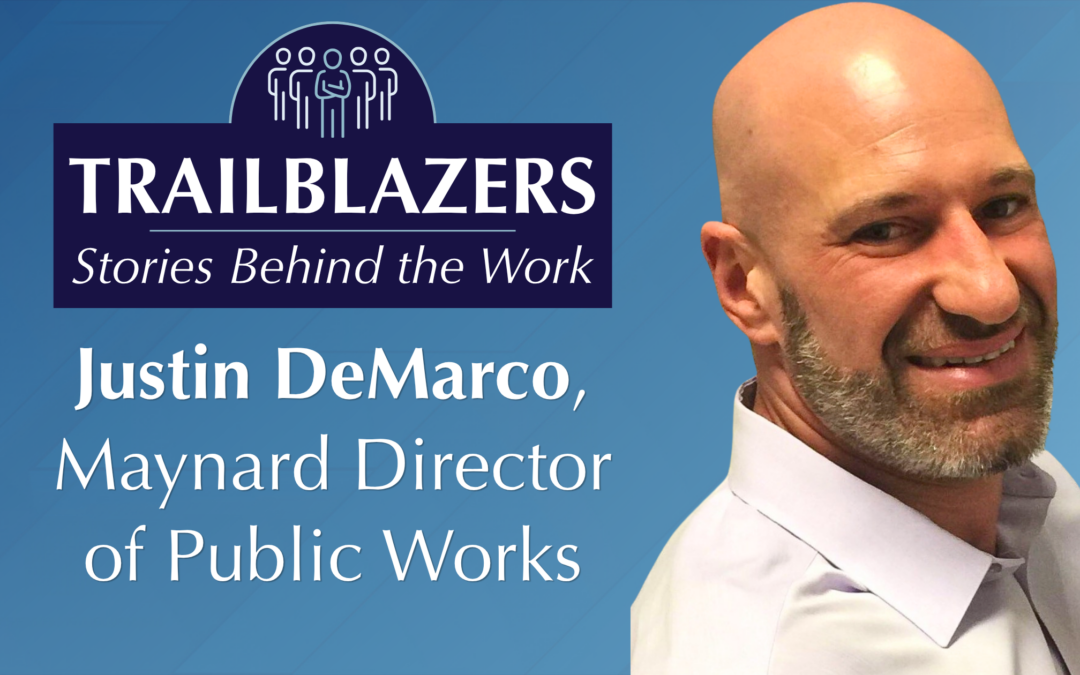
Long before Justin DeMarco became Maynard's Director of Public Works, he was a boy growing up on the same street as the Department of Public Works in Marlborough. He watched trucks and equipment pass his house through summer construction and winter storms, fascinated by the work happening just outside his door.
That early curiosity became a career grounded in a simple idea: public works may operate behind the scenes, but it shapes nearly every part of daily life. Roads, water, sewer, facilities, trees, drainage and even Maynard's public golf course all depend on people planning, maintaining and responding - often before most residents realize there is a problem.
"Our programs are the only service in municipal government that affects every resident in multiple ways. As a resident, your water turns on and you never think about how it got there, or you flush your toilet and you just think it magically disappears. Our department is only thought about when something fails."
The Team Behind the Team
A coach and sports fan, DeMarco compares public works to an offensive line. Quarterbacks may receive the attention, but their success depends on the people protecting them play after play. When the line is working, few people notice. When it breaks down, everyone does.
The same is true in local government. Fire protection depends on water systems and passable roads. Schools depend on safe facilities and reliable infrastructure. Residents and businesses rely on services that must function every day, in every season. Public works supports each of those systems, even when its role is largely invisible.
For DeMarco, moving from Marlborough to Maynard was an opportunity to keep growing while putting his leadership values into practice. He believes municipal departments cannot rely on the status quo simply because a process is familiar. Public-sector leadership, he said, should be driven by adaptation, improvement and the needs of the community.
City Level Services on a Small-Town Scale
Maynard presents a distinct leadership challenge. The community expects a broad range of public works services, but the department delivers them with the resources of a smaller town. That means nearly every decision requires a clear understanding of what is essential now, what can wait, and what investment will prevent a larger problem later.
DeMarco describes his approach as servant leadership. The infrastructure and programs his team manages belong to the community, so residents and other stakeholders need a meaningful role in setting priorities. His responsibility is to listen, explain the tradeoffs and help separate needs from wants without losing sight of the town's larger goals.
"Our community stakeholders typically identify their most important concerns, and my role is to help educate and guide them by disseminating what a need is and what a want is."
That shared understanding, he believes, creates a more unified path toward the work that will keep municipal systems operating safely and effectively.
Water at the Center of Maynard's Future
No issue illustrates those competing pressures more clearly than drinking water. Maynard treats and distributes its own water without an alternate source through an interconnection or regional provider. DeMarco said the system faces interconnected challenges involving production capacity, water quality and the town's ability to support future housing and commercial growth.
The work is not only technical. Water capacity can influence development, tax revenue and the resources available for townwide services. Addressing the system therefore requires long-term infrastructure planning, public understanding and collaboration well beyond the walls of the DPW.
That reality came into sharp focus in September 2026, when a major water main break caused Maynard’s storage tanks to lose approximately 1.5 million gallons of water: about one-third of the town’s total storage capacity. DPW crews traced the loss, located the break and isolated the affected portion of the system while the community worked together to conserve water.
The response brought rare public attention to the people behind the water system. State Senator Jamie Eldridge later thanked Maynard’s Water and Sewer Department for its work during the emergency, a fitting example of DeMarco’s description of public works as largely unseen when systems are functioning, but indispensable when something goes wrong.
DeMarco sees regional cooperation as an important part of the solution. Massachusetts municipalities have traditionally planned major water, sewer and stormwater systems independently, even when neighboring communities are working toward similar goals under the same regulatory standards. More coordinated approaches, he believes, could make better use of public funding while creating stronger and more resilient systems.
Planning Beyond the Next Emergency
Public works leaders live in two timelines at once. A water main break, snowstorm or failed piece of equipment may require an immediate response, while replacement schedules and capital plans must look years or decades ahead.
DeMarco believes the industry has too often been pulled toward daily operations at the expense of long-term planning. The result is a cycle in which departments repeatedly react to failures rather than investing early enough to prevent them. Consistent leadership, thoughtful capital planning and a willingness to improve old processes can help break that cycle.
His collaborative management style supports that work. Instead of relying on a strictly top-down hierarchy, DeMarco favors a horizontal approach that makes use of the strengths of employees, engineers, contractors, regulators, elected officials and residents. When each person understands their responsibility and trusts others to carry out theirs, he said, government can work more efficiently toward a shared goal.
Investing in the People Who Make It Work
Even the strongest infrastructure plan depends on a skilled workforce. Public works departments and water utilities across the country are struggling to recruit and retain employees as private-sector salaries and benefits become more competitive and public employees face increasing technical, regulatory and administrative demands.
DeMarco believes communities must value the people behind essential services as deliberately as they value the infrastructure itself. That means investing in compensation, training and education, while introducing students and early-career workers to the range of opportunities available in public works.
Those opportunities are broader than many people realize. A public works career can cross multiple technical specialties and provide the stability, challenge and room for growth that DeMarco found compelling from the beginning. It is also, unmistakably, a service career.
"You do not pursue public service as a lucrative endeavor, and success and happiness are achieved when you have a personal altruistic value system."
His shorthand is even more direct: if you like to be challenged and value stability, public works may be a great fit. If the goal is simply to get rich, it probably is not.
A Changing Field with Familiar Stakes
The tools of the profession continue to change. DeMarco expects artificial intelligence to have a significant effect on municipal operations, particularly as communities confront workforce shortages and growing regulatory requirements. He sees opportunities to use automation not only in water and wastewater systems, where it is already well established, but also in administrative processing, customer service and work-order routing.
Technology may help departments stretch limited resources, but it will not replace the judgment, trust and commitment at the center of public service. For DeMarco, leadership still comes back to listening to the community, planning beyond the immediate problem and supporting the people responsible for keeping essential systems running.
And after years in public works, he knows that silence is not always reassuring. Asked to identify the most dangerous phrase a DPW director can hear, DeMarco did not choose, "It's only a little snow," "It's just one pothole" or even "While I have you."
About the Series: Trailblazers at Capital Strategic Solutions
At CSS, we believe progress is driven by people who challenge expectations, redefine possibilities, and lead with purpose. Our Trailblazers series highlights individuals whose careers reflect resilience, innovation, and a commitment to excellence across industries.
These stories go beyond titles and accomplishments. They explore the pivotal moments, lessons learned, and personal drive that shape meaningful careers. From overcoming uncertainty to breaking barriers in traditionally underrepresented fields, each feature offers insight into what it truly takes to lead and succeed.
Through Trailblazers, we aim to inspire the next generation of leaders while celebrating those who are making a lasting impact today.
Know someone whose story deserves to be told? We're always looking for the next Trailblazer to feature. If you know a leader whose journey embodies resilience, innovation, and purpose, we'd love to hear about them, nominate them today and help us shine a light on the people shaping the future.
CONTACT US