
When an emergency happens, sending an alert is only one part of the response.
Before information reaches the public, someone must confirm what happened, understand the operational impact, determine what people need to do, approve the message, distribute it across multiple channels, and continue providing updates as conditions change.
That process may involve leadership, public safety, public works, utilities, communications staff, technology providers, volunteers, community organizations, and outside partners. If those pieces are not coordinated, even the best alert platform cannot solve the problem. Emergency communications are not simply a communications function. They sit at the intersection of operations, infrastructure, technology, public safety, workforce coordination, community engagement, and funding.
Organizations need more than a collection of individual plans. They need one coordinated system—and a team that understands how all the pieces fit together.
Preparedness Is a Multidisciplinary Responsibility
Every organization faces different risks.
A municipality may need to communicate during a severe storm, extended power outage, road closure, or public safety incident. A utility may need to notify customers about a service disruption or water-quality concern. A healthcare or human services organization may need to maintain continuity while protecting vulnerable populations. A school, nonprofit, or private business may need to coordinate staff, facilities, technology, and public information during an unexpected disruption.
The circumstances may differ, but the underlying challenge is the same: people, procedures, infrastructure, and information must work together under pressure.
Organizations can begin assessing their readiness by asking five practical questions.
Can We Reach People If One System Fails?
Text and email alerts are valuable, but no single communication method will reach everyone.
Power outages can affect internet access. Cellular coverage may be inconsistent. Some people may not use social media or regularly visit an organization’s website. Others may need translated, accessible, or directly delivered information.
A resilient communications strategy uses multiple channels to reinforce the same accurate, actionable message. Determining which channels to use requires an understanding of the organization’s audiences, technology, infrastructure, and available resources.
Does Everyone Understand Their Role?
Emergency information can become delayed or inconsistent when responsibilities are unclear.
Organizations should identify who gathers operational information, verifies facts, approves messages, distributes alerts, responds to media inquiries, coordinates with partner agencies, and provides subsequent updates. Backup personnel should also be designated in case primary staff are unavailable.
This is not simply a messaging exercise. It requires organizational planning, clearly defined authority, staff training, and coordination across departments or business functions.
Are Essential Messages Prepared in Advance?
Staff should not have to begin with a blank page during a severe storm, evacuation, service interruption, facility closure, shelter activation, cybersecurity incident, or other emergency.
Preapproved templates provide a reliable starting point while allowing staff to add incident-specific information. Prepared materials also help organizations communicate consistently, maintain accessibility, and avoid leaving out essential instructions.
The strongest templates are informed by the operational plan behind them. The people drafting the message must understand what is happening, who is affected, what resources are available, and what actions are realistic.
Can Internal Teams and Outside Partners Communicate?
Public communication depends on strong internal communication.
Leadership, operations staff, emergency responders, utilities, technology teams, facilities personnel, volunteers, vendors, and community partners must be able to exchange accurate information, even when normal systems are disrupted.
Radio compatibility, backup power, updated contact lists, staffing plans, reporting procedures, and clear decision-making authority all influence whether reliable information ultimately reaches the people who need it.
Has the Entire System Been Tested?
A plan may look complete on paper and still contain gaps that only become visible during an exercise or real emergency.
Organizations should periodically test alert platforms, contact information, approval procedures, backup systems, staff responsibilities, equipment, and coordination with outside partners. Exercises help teams understand how one part of the organization affects another and reveal where additional training, investment, or planning may be needed.
Testing can also produce a clearer roadmap for future improvements and help organizations identify grants or other funding sources that may support implementation.
Project Spotlight
A Multidisciplinary Approach in Petersham
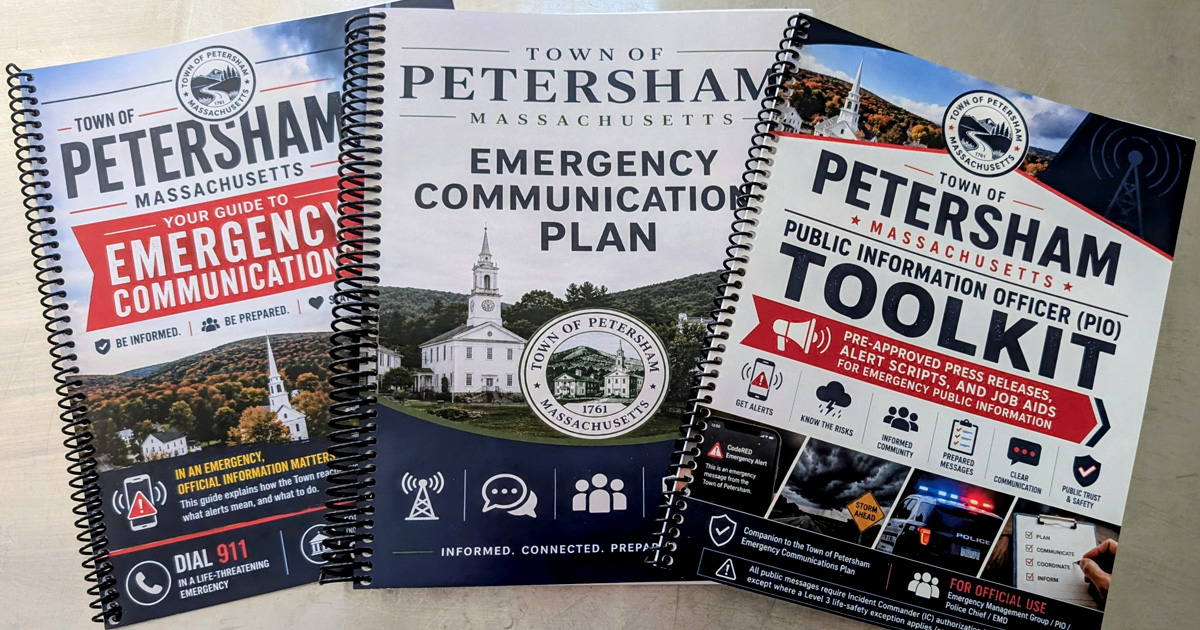
These questions were central to Capital Strategic Solutions’ work with the Town of Petersham and radio communications specialist LB Comms.
Petersham faces conditions familiar to many rural communities: dispersed households, limited cellular coverage, an aging population, private wells that stop operating during power outages, and the potential for severe weather and extended service disruptions.
Those realities meant the Town could not rely on one alert platform, one department, or a generic emergency plan.
One interconnected system
Supported by Municipal Vulnerability Preparedness funding, the project brought together several disciplines to create:
- An ICS/NIMS-aligned Emergency Communications Plan
- A plain-language Community Emergency Guide
- Preapproved alerts and press-release templates
- A review of radio systems and interoperability
- An assessment of communications and operational practices
- Volunteer and staff training recommendations
- Prioritized improvements connected to potential funding sources
CSS led the planning process by bringing together emergency management, public safety, communications, community engagement, project coordination, and grant strategy. LB Comms contributed the specialized radio and interoperability expertise necessary to evaluate the Town’s technical communications environment.
Each discipline informed the others. Technical gaps affected operational recommendations. Community needs shaped the communications strategy. The assessment identified training priorities, and the funding analysis provided a path for moving recommendations toward implementation.
The result was not a collection of disconnected reports. It was one coordinated body of work designed around Petersham’s people, terrain, infrastructure, staffing, and available resources.

Specialized partnership, integrated result.
CSS and LB Comms combined planning, public safety, communications, funding, radio, and interoperability expertise within one coordinated project team.
One Team That Understands the Whole Picture
The Petersham project reflects the broader way CSS brings together expertise in strategic advisory, public finance, infrastructure, emergency management, public safety, communications, human resources, organizational development, project management, and grant administration as a multidisciplinary consulting and operational support firm.
That range matters because emergencies rarely stay within the boundaries of one department or professional discipline.
A service interruption becomes a customer-communications issue. A power outage becomes an infrastructure, staffing, and continuity challenge. A public safety incident requires operational coordination and trusted public information. A resilience assessment may uncover improvements that require grant funding, procurement support, training, and long-term project oversight.
Organizations should not need to coordinate a dozen disconnected vendors to solve a challenge that crosses a dozen functional areas. They need a team capable of seeing the entire picture, identifying how the pieces affect one another, and translating recommendations into practical next steps.
Preparedness Is a Continuing Process
Emergency readiness is not achieved by adopting a plan once. Contact lists change. Staff members take on new responsibilities. Technology evolves. Facilities and infrastructure age. Community needs shift. New risks emerge, and exercises reveal opportunities for improvement. Plans must be reviewed, tested, funded, and updated regularly so they remain useful when conditions are anything but routine.
Whether supporting a municipality, utility, school, healthcare provider, nonprofit, or private organization, CSS meets clients where they are. We can assist with one immediate need or coordinate a broader program involving planning, operations, communications, training, funding, and implementation.
Is your organization ready when normal systems are disrupted?
Let’s talk about how your team can communicate clearly, coordinate effectively, and continue operating under pressure.
Start the Conversation