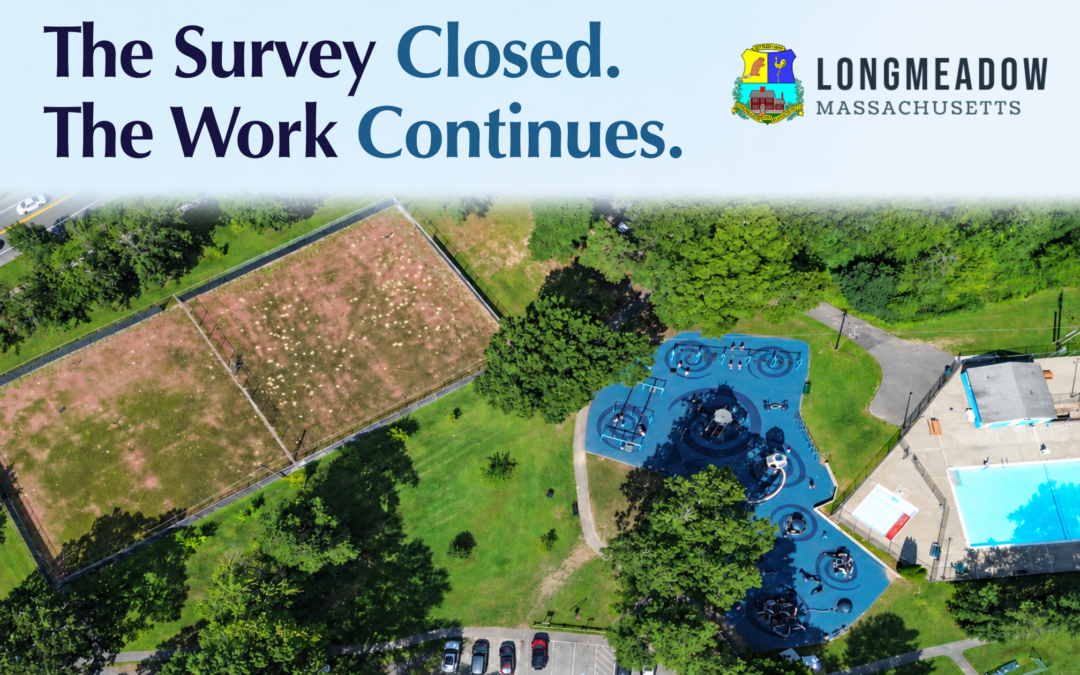
A behind-the-scenes look at what happens after the last response comes in, from our work on Longmeadow’s Bliss Park study.
The survey link stops working. The intercept table gets folded up and carried back to the car. The response count stops climbing. For a lot of projects, that’s where the public engagement story ends. For us, it’s where the interesting part starts.
CSS is leading outreach and engagement for the Bliss Park Clay Courts Alternatives Study for the Town of Longmeadow, which asks a deceptively simple question: what should happen with the four clay tennis courts at the center of one of the Town’s signature parks? The Town isn’t looking to validate a predetermined answer. It wants an objective, community-driven evaluation. So, we started by listening, and now we want to show you what we do with what we heard.
What We Did to Hear from People
We didn’t rely on a single channel.
- Nearly 1 in 14 Longmeadow residents helped shape the conversation, with the community survey drawing 1,122 responses, 97% from town residents.
- Three focus groups, for youth sports, tennis and pickleball players, and abutting neighbors, let us have candid, stakeholder-specific conversations instead of one crowded room.
- Boots-on-the-ground outreach, including an intercept survey at the Friends of Storrs Library book sale, took the conversation to people who might never click a link on a town website.
Each channel reaches different people. Together, they give a much fuller picture than any single channel could.
Step 1 Don’t Mistake a Survey for a Vote
Once the data is in, the temptation is to look for a winner. We look for a shape.
A passionate group and a broad middle can point in different directions, and both matter. Reading only the top line would hide that. The real story is the full range of community priorities, which gives the Town options rather than a single answer.
Step 2 Check Who We Actually Heard From
High turnout is a good sign, but we still ask who showed up.
We compare respondents to the community as a whole: Did families weigh in? Longtime users of the park? Residents who rarely visit? Different groups often see the same space very differently. Neither view is wrong, and we’d rather show both than smooth them over.
Step 3 Test Our Assumptions Against the Data
It’s easy to assume how the people living closest to a project will feel. We check instead.
Neighbors’ concerns are real, and they came up in both survey responses and written comments. Hundreds of respondents took the time to write something in. Those concerns get tested rather than dismissed or assumed away.
Step 4 Turn Concerns into Analysis
When residents raise issues like parking, traffic, or noise, the answer isn’t a guess. It’s an assessment. BETA Group evaluates site conditions, infrastructure and lighting needs, traffic and parking considerations, and capital and maintenance costs for potential uses. Tech Environmental contributes noise monitoring and acoustical modeling. Together, these findings help the Town weigh community ideas against practical constraints and neighborhood impacts.
Step 5 Show Our Work, and Keep People in the Loop
The next phase is a comparative evaluation of alternatives, scored against the same criteria for every option. Then comes a draft report and a public presentation, where residents can respond before anything is finalized.
Many respondents also opted in for project updates. We’re not going to waste that. It’s an open line to people who care about the outcome.
What this Means for Your Community
A closed survey isn’t an answer. It’s a better set of questions: What do people want? Where do they disagree? What does the data say about feasibility? How do we keep everyone involved as decisions get made?
Communities that answer those questions in the open, and show their work along the way, build trust that carries into the next project.
Like What You See?
This is how we work: out in the community, listening first, and backing up every recommendation with real data. If your town has a project that needs public input, and a plan for what to do with it, please reach out. At CSS, we believe meaningful public engagement doesn't end when the survey closes. It continues through thoughtful analysis, transparent communication, and recommendations that reflect both community priorities and practical realities.
Whether your municipality is evaluating a public facility, planning a capital investment, or navigating a complex community decision, CSS can help turn public input into a clear path forward.